By Andrew Adams · Co-Founder & Lead IT Consultant · The Link Source
Why Local Antivirus Isn't Enough to Protect Your Business
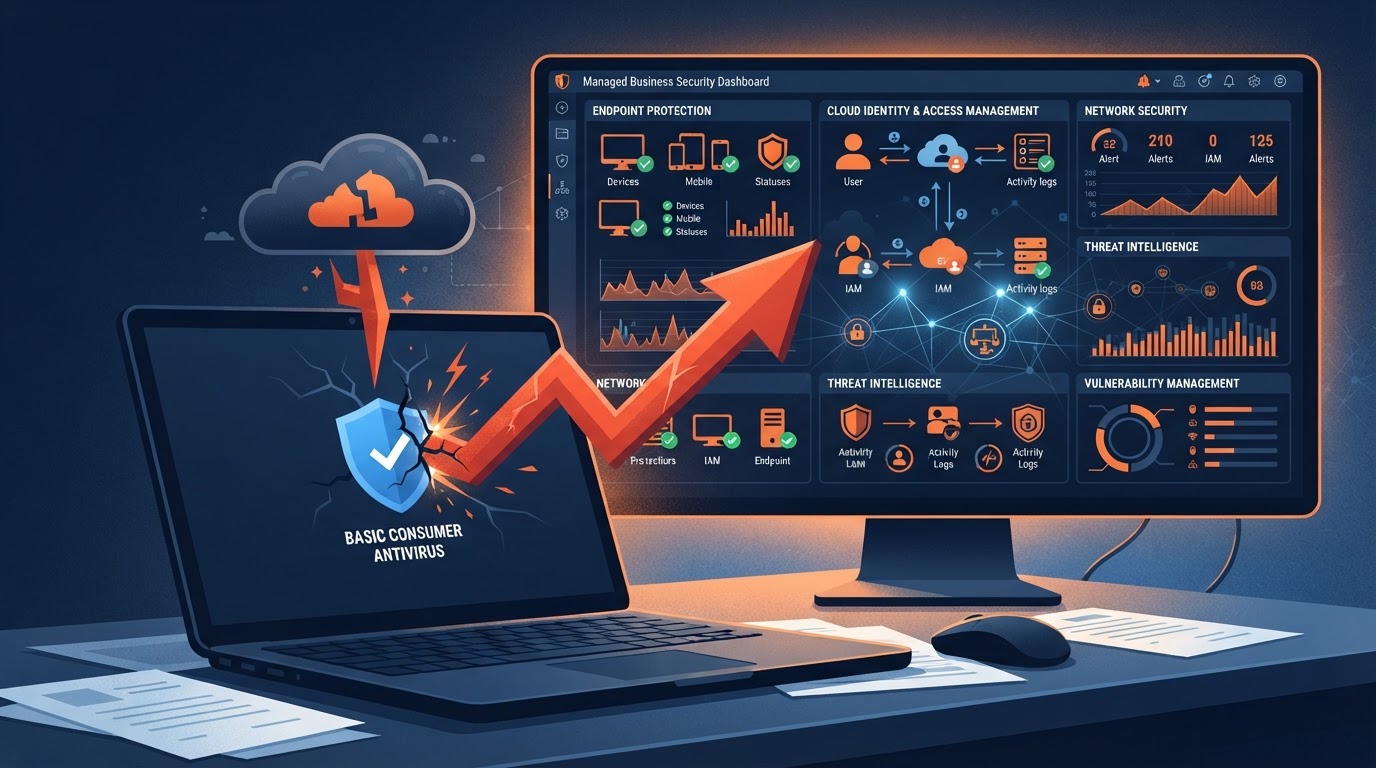
A company asked if upgrading their consumer McAfee was a good business security solution. Here's why the antivirus that comes with your computer isn't built for business — and what a managed solution should actually cover.
A company recently reached out and asked us a straightforward question: "We're thinking about upgrading our McAfee account — do you think that's a good security solution for our business?"
It's a reasonable question, and we appreciated that they asked before buying. But our answer was honest: not for a business. The McAfee (or Norton, or similar) that comes pre-installed on a consumer computer is built for an individual sitting at home — not for a company that has employees, cloud accounts, shared data, and attackers actively targeting them.
We recommended something different: a managed business security solution that covers both the endpoint and their cloud identities (Microsoft 365 and Google Workspace). Here's why that matters, and why the antivirus that shipped with your laptop isn't enough to protect your business.
Key Takeaways
- Consumer antivirus (like pre-installed McAfee) is built for one home user on one device — it is not designed to manage, monitor, or report across a business with multiple employees and shared data.
- It relies on known signatures and only catches threats it has already seen, while modern attackers generate thousands of new variants per day specifically to evade it.
- It does not look for compromised indicators — suspicious logins, planted OAuth tokens, or hidden email forwarding rules — so a cloud account compromise can go undetected for days.
- Your biggest risk is no longer just the device; it is your Microsoft 365 and Google Workspace cloud identities, which consumer antivirus cannot see at all.
- A managed business solution covers endpoint and cloud identities, with behavioral detection, centralized reporting, 24/7 monitoring, and human review of alerts.
Consumer Antivirus Was Built for Home, Not for Business
The antivirus software that comes bundled with a new computer is designed for a single user protecting a single device. It looks for known viruses using a signature database — essentially a list of bad files it has seen before. If a file matches the list, it gets blocked. If it doesn't, it runs.
That model worked reasonably well twenty years ago. Today, it has two fundamental problems for any business:
- It only knows what it has already seen. Modern attacks are built to evade signature-based detection. Attackers generate new variants constantly — thousands per day — specifically so they don't match any known signature. By the time a consumer antivirus "knows" about a threat, it has already been used against businesses like yours.
- It isn't looking for compromised indicators. Consumer antivirus checks files as they arrive. It does not monitor for the signs that an account has already been compromised — suspicious logins, OAuth tokens planted in a mailbox, hidden email forwarding rules, or data being exfiltrated to an unfamiliar location. By the time the antivirus notices, the attacker has often been inside for days.
The Threat Has Moved Beyond the Device
Here's the part that catches most businesses off guard: your biggest risk is no longer just a malicious file on a laptop. It's your cloud identities.
When an attacker compromises a Microsoft 365 or Google Workspace account, they rarely need to install malware on a device at all. They log in with stolen credentials, plant an OAuth app that survives a password reset, set up hidden inbox rules, and quietly read every email that flows through the account. Consumer antivirus running on a laptop will never see any of this — because none of it happens on the laptop. It happens in the cloud, behind the login you already trust.
This is exactly the kind of compromise we've helped companies recover from. An attacker holds access for days or weeks with no malware on the endpoint at all. A signature-based antivirus has nothing to scan and nothing to flag.
What a Managed Business Security Solution Actually Covers
A real business security stack protects more than the device. It protects the identity, the data, and the ability to detect a problem early. Here's what that looks like:
1. Endpoint Protection With Behavioral Detection
Instead of relying only on known-bad file signatures, a business-grade endpoint solution uses behavioral analysis and machine learning to stop never-before-seen threats. If a file starts behaving like malware — even if no signature exists for it — it gets quarantined before it can execute. This is the layer that catches the new variants consumer antivirus misses.
2. Cloud Identity Protection
This is the piece consumer antivirus can't touch at all. A managed solution monitors your Microsoft 365 and Google Workspace environments for the real signs of compromise: impossible-travel logins, new OAuth app registrations, suspicious inbox rules, mass email forwarding, and admin privilege changes. When something looks wrong, your IT team gets alerted — not after the damage is done, but while there's still time to cut the attacker off.
3. Centralized Management and Reporting
Consumer antivirus runs on each device independently. There's no single view of your security posture, no way to confirm every machine is protected and up to date, and no audit trail. A managed business solution gives you a central dashboard showing the status of every endpoint, every alert, and every remediation — so you can prove to your insurer, your clients, and your auditors that your business is actually protected.
4. 24/7 Monitoring and Human Review
Software catches threats, but someone has to review what it catches. A managed solution pairs the technology with a team that investigates alerts, confirms whether a threat is real, and responds — often before your employees even know something happened. Consumer antivirus sends a pop-up and hopes for the best.
5. Web Filtering and Threat Intelligence
Business-grade protection blocks access to known malicious sites before an employee ever reaches a dangerous download, and it's fed by real-time threat intelligence that updates continuously. Consumer antivirus reacts after the fact.
The Bottom Line
The antivirus that comes with your computer is better than nothing — but only barely, and only for a single home user. For a business, it's a false sense of security. It watches the device and ignores the cloud identities where the most damaging attacks actually happen. It relies on signatures that attackers are specifically designed to evade. And it gives you no central visibility, no monitoring, and no one to respond when something goes wrong at 1:00 AM.
If you're relying on consumer antivirus to protect your business, you're betting that no attacker will ever use a method your software hasn't already seen. That's a bet the attackers are happy to take.
At The Link Source, we deploy and manage business-grade security that covers your endpoints and your cloud identities, monitors around the clock, and is backed by a team that reviews and responds to threats before they become incidents. It's all part of our managed IT services, built to keep Houston businesses secure without adding overhead. If you're not sure whether your current protection is actually built for a business, contact us today — we'll give you an honest assessment and show you exactly where your gaps are.
Article FAQ
Is McAfee enough to protect a small business?
No. The consumer version of McAfee that comes pre-installed on a computer is built for a single home user on a single device. It relies on known virus signatures and does not manage, monitor, or report across multiple employees, and it cannot see attacks happening inside your Microsoft 365 or Google Workspace cloud accounts. A business needs a managed solution that covers both the endpoint and cloud identities.
Why does consumer antivirus miss cloud account compromises?
Because cloud account compromise does not happen on the device. An attacker logs in with stolen credentials, plants an OAuth app that survives a password reset, and sets up hidden inbox rules — all inside your cloud environment. Consumer antivirus running on a laptop has nothing to scan and nothing to flag, since none of the activity touches the device. Only cloud identity monitoring can detect it.
What does a managed business security solution include?
It includes behavioral endpoint protection that catches never-before-seen threats, cloud identity monitoring for Microsoft 365 and Google Workspace, centralized management and reporting across all devices, 24/7 monitoring with human review of alerts, and web filtering powered by real-time threat intelligence. Consumer antivirus offers none of these.
Can managed antivirus detect a compromised email account?
Yes, when it includes cloud identity protection. It watches for the real signs of compromise — impossible-travel logins, new OAuth app registrations, suspicious inbox rules, mass email forwarding, and admin privilege changes — and alerts your IT team while there is still time to cut the attacker off. Consumer antivirus cannot detect any of this.
